
Person Projected Release Dates
A projected release date is a current sentence calculation. It is not proof that the person left custody. NCDAC can revise the date when credit, discipline, another sentence, a court action, or the statutory supervision structure changes. The historical record later supplies an accomplished release date. Keep the two fields separate when saving or comparing records.
A pretrial detainee at the Person County Detention Center has no sentence-based release date. Release can depend on bond, dismissal, a new court order, or another custody event. A locally sentenced misdemeanant may have a calculated end date, but the jail remains the source for its current calculation. A state prisoner belongs in NCDAC. A federal prisoner belongs in BOP. Custody type comes before arithmetic.
| Record | What it establishes | Best source |
|---|---|---|
| Projected date | A changeable sentence calculation | NCDAC detail or local custodian |
| Court judgment | The sentence, minimum, maximum, and ordered credit | eCourts or clerk |
| Actual release date | An accomplished prison or jail exit | NCDAC history or sheriff record |
| Supervision status | Whether community control continues | NCDAC offender detail |
Find Person Projected Release Records
For a North Carolina state prisoner, open the NCDAC Offender Public Information search. Use the offender number when possible. A name search can be narrowed by first name, middle initial, date of birth with a year range, age, sex, race, or ethnic group. The sounds-like option helps with spelling, but it can create more false matches. NCDAC expressly excludes county-jail information.
- Select Active Inmate for a person now believed to be in state prison. Choose All when the state status is uncertain.
- Enter the offender number or a closely matched name and birth detail. Open only a result that fits the known identity.
- Compare the offender number, offense, conviction county, admission, sentence episode, and any displayed projected date.
- Read the supervision fields. A move to PRS is release from prison but not the end of the sentence.
- After the event, search Inactive and record the accomplished date rather than retaining an old projection.
The official state form and detail path below shows where identity, status, and a live projected field may appear.
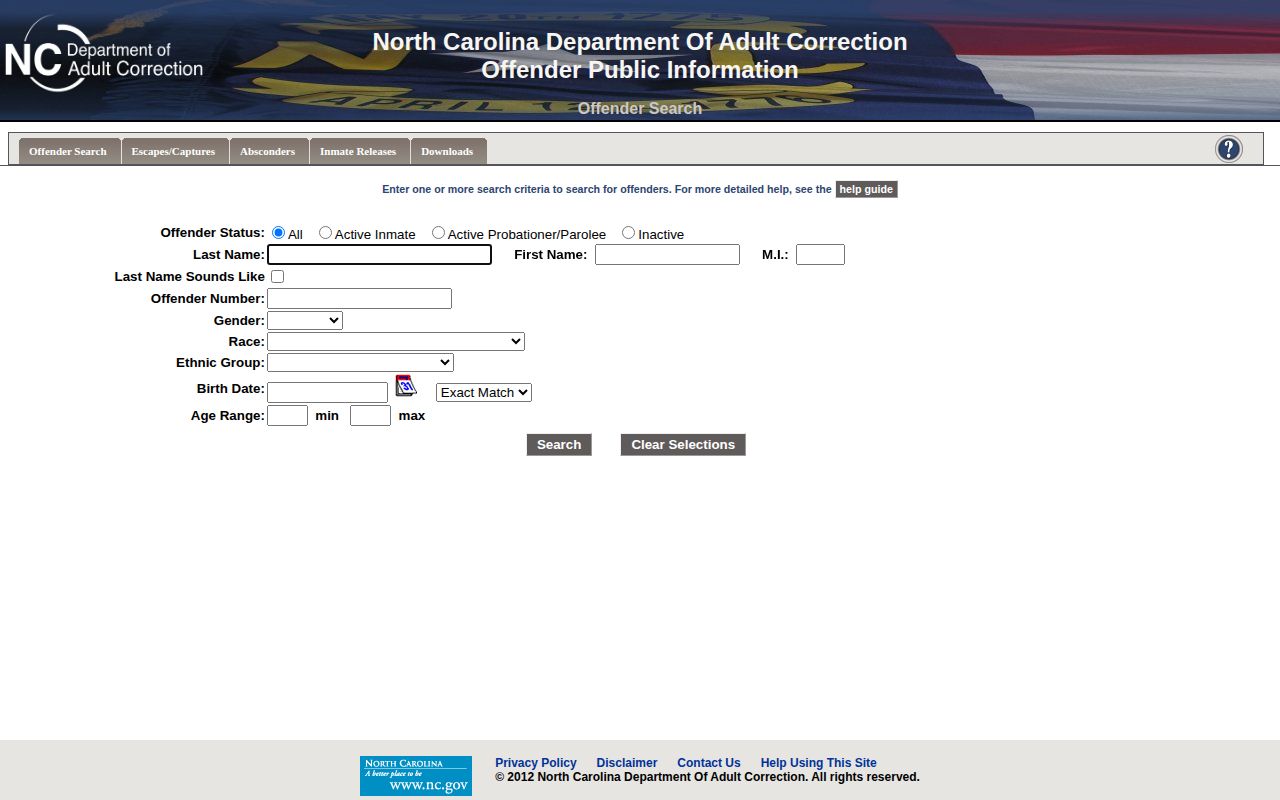
One person may have several sentence episodes. Tie the projected date to the relevant admission and judgment instead of choosing the most recent date on sight.
Person County Jail Release Dates
The Person County Detention Center holds local detainees and can also hold people under other legal authority. For a sentenced local misdemeanor, call 336-597-0525 and ask for the current calculated date, applied jail credit, and earned-time treatment. Person County publishes no local credit table, weekend-release rule, or release-processing schedule. A judgment plus homemade arithmetic is not a safe substitute for the custodian's calculation.
For documentary proof, use Person County NextRequest and identify the booking episode. Ask for the entry-and-release summary, booking number, recorded release date and time, release code, and destination. If the person is awaiting trial, use eCourts to check bond and court orders, but remember that a court order shows legal authority. It does not necessarily record when the jail completed processing or whether another hold remained.
A useful local request separates the calculation from the completed event. Ask first for the current calculated date and posted credits if a county sentence is still active. Then ask for the entry-and-release record after custody ends. The second record should be read for the actual time, exit reason, and destination. A release to NCDAC, USMS, ICE, or another jail is a transfer between custodians even though Person County closed its own custody episode.
Three-way check: Ask whether the person is still confined, released to the community, or transferred to another custodian.
Person Release Minimum Terms
North Carolina Structured Sentencing uses a minimum and a maximum. NCDAC's victim-support release-date explanation says the person serves 100 percent of the minimum, with judge-ordered jail credit applied to that minimum. Earned time works within the lawful maximum structure. It cannot cut a felony below the minimum term under N.C.G.S. § 15A-1340.13(d).
The official state explanation is captured below.

This is why the familiar “85 percent” phrase is easy to misuse. NCDAC describes Structured Sentencing as at least 100 percent of the minimum and 85 percent of the maximum, followed by PRS for felony terms. Do not multiply every sentence by .85. The judgment, credit, offense class, earned time, and PRS structure must be read together.
The felony minimum-term statute below supplies the governing limit.
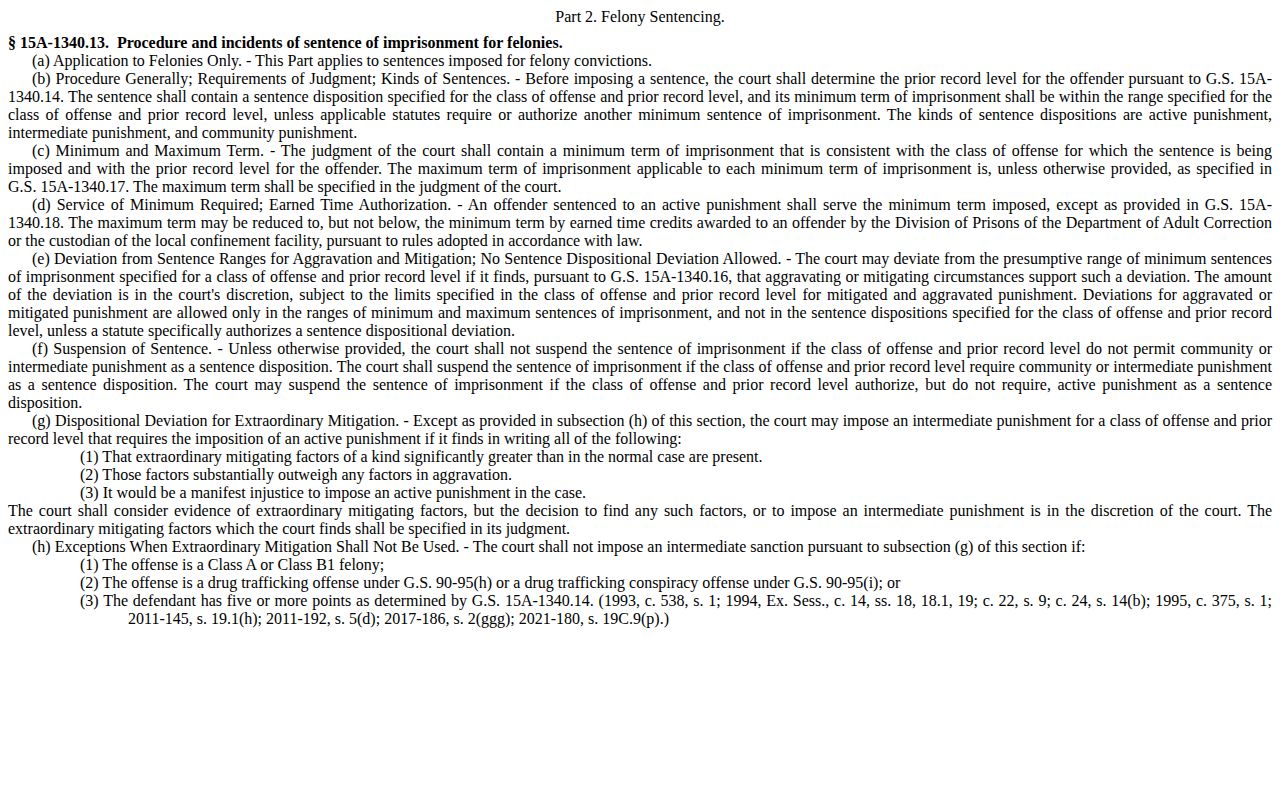
The live NCDAC date remains the operational source for a state prisoner. Statute text explains the rule but does not calculate the individual record.
Person Release Earned Time
Section 148-13(a1) authorizes NCDAC rules for awarding and forfeiting earned time. Subsection (e) extends applicable regulations to sentenced jail prisoners. For misdemeanors, N.C.G.S. § 15A-1340.20(d) authorizes earned time but caps it at four days per month of incarceration. The county custodian still must apply the lawful rule to the actual judgment and custody record.
Earned time is not a universal daily discount. Conduct, offense date, sentence class, custody credit, and later orders can affect the record. If a Person County local sentence is involved, ask what credit has actually been posted. If a state sentence is involved, read the NCDAC field and request clarification from NCDAC when the public detail does not resolve the calculation.
Consider a local misdemeanor judgment with a stated term and judge-ordered custody credit. The statute may permit earned time up to its cap, but only the custodian can say what was awarded and whether any later event changed it. The safe result is the jail's posted calculation, not a best-case estimate. For a felony, the same principle applies through NCDAC, with the added minimum, maximum, and PRS structure.
- Jail credit
- Time a judge orders credited toward the sentence, often for confinement before judgment.
- Earned time
- Credit awarded under correctional rules and limited by the sentence law.
- Maximum term
- The upper sentence term against which earned time and PRS structure may operate.
- Projected date
- The agency's current estimate, subject to lawful change.
Note: The Person County site publishes no local earned-time table, so an individual misdemeanor date must come from the jail's own calculation.
Person Release Date and PRS
A felony maximum includes a period designed for post-release supervision. Under Article 84A, release to PRS generally occurs at maximum less 12 months for classes B1 through E and less nine months for classes F through I, with statutory adjustments. Certain registration-reportable offenses use a five-year supervision term and special maximum structures. Completion of PRS terminates the sentence.
This structure explains why the prison exit may occur before the full maximum expires. The remaining span is not erased. It is served through community supervision. Earned credits may reduce supervision, but not by more than 20 percent of its original length. For a Person County result, compare the prison release date, supervision start, active or inactive status, and eventual termination date. The Person County post-release supervision check covers that verification path.
Why Person Release Dates Change
A projected date can move for more than one reason. The event should be traced to the source that controls it, not guessed from a changed number. A recalculation may be lawful even when the public page does not explain each internal step.
| Factor | Possible effect | Where to verify |
|---|---|---|
| Jail credit | Moves the minimum calculation when ordered or corrected | Judgment and NCDAC or jail record |
| Earned time | Reduces eligible time within statutory limits | Custodian's live calculation |
| Discipline | May cause credit loss or a later projection | NCDAC calculation or record request |
| New sentence or court order | Adds, changes, or corrects time | eCourts and correctional record |
| Detainer or transfer | Changes destination without proving community release | Holding and receiving agencies |
| PRS or older-law parole | Changes the type of custody transition | NCDAC and Commission record |
An old-law parole-eligible sentence must not be forced into the Structured Sentencing shorthand. Check the offense date and N.C.G.S. § 15A-1371. The Commission's monthly report is a review-results source, not a date calculator.
Consecutive and concurrent sentences can also create a date that looks wrong when only one judgment is read. Consecutive terms run one after another. Concurrent terms overlap as the judgment permits. A later revocation can add a new custody episode. Match every displayed date to its sentence segment before deciding that NCDAC or the court record conflicts.
Confirm Person Actual Release
After the expected date, confirm the completed event. For state custody, search NCDAC under Inactive or All and read the accomplished release and supervision history. For a county episode, call the Detention Center and request the sheriff's entry-and-release summary when a historical document is needed. A court order can explain the legal cause, while the custodian records the physical exit.
NC SAVAN/VINELink may send a custody-change notice, but it is a notification mirror rather than the certified release record. Record the reporting agency and exact status, then corroborate. A “released” alert can describe departure from one agency and still be followed by transfer to NCDAC, USMS, or ICE. Use the VINE Inmate Check for a matched alert and registration steps.
Save the source, status wording, and time observed. If the expected date passes without an accomplished entry, contact the custodian rather than assuming an error or release. A new court order, unposted credit change, other sentence, or receiving-agency hold may explain the gap. Ask for the field definition when two records use “release date” differently.
A complete Person County timeline can show an order time, a processed jail exit, a transfer intake, a later prison release to PRS, and a final discharge. Those are separate facts. Precise verbs such as ordered, transferred, released to PRS, and discharged prevent one date from being mistaken for all of them.