
Person County Federal Releases
The Federal Bureau of Prisons holds sentenced federal prisoners and maintains the public locator used for its custody history. It is not the same as the United States Marshals Service, which manages many pretrial detainees, writs, and transports. A person can be under USMS authority while temporarily housed in a county or contract bed before designation to BOP.
No BOP institution was found in Person County. A Person County Detention Center record that names BOP, USMS, or “federal” should be copied exactly. That destination phrase identifies the next inquiry. It does not turn the county jail into a federal prison, and it does not show that a person returned to the community.
| Federal stage | Best public source |
|---|---|
| Federal court detention or release order | Federal case docket |
| Pretrial transport or writ | USMS context and docket |
| Sentenced and designated prisoner | BOP Inmate Locator |
| Departure from BOP custody | BOP release date and location |
| Federal supervised release | Court judgment, docket, and probation information |
Confirm BOP Release Status
Open the BOP Inmate Locator. Search by register number when possible because it is more precise than a name. A name search should be checked against age, race, sex, and register number. The result can show name, register number, age, race, sex, release date, and location.
- Search by federal register number or full name.
- Compare every displayed identifier before selecting a record.
- Read the release date and location together.
- Treat RELEASED or no BOP facility as departure from BOP custody only.
- Check the federal docket and other custodians when supervision or transfer remains possible.
The locator covers federal inmates released after 1982. Earlier records generally require the National Archives. BOP also cautions that First Step Act calculations can affect displayed dates, so a future date remains subject to change. A past accomplished date has a different meaning from a current projection.
The official locator capture illustrates the identity fields and released-location result.
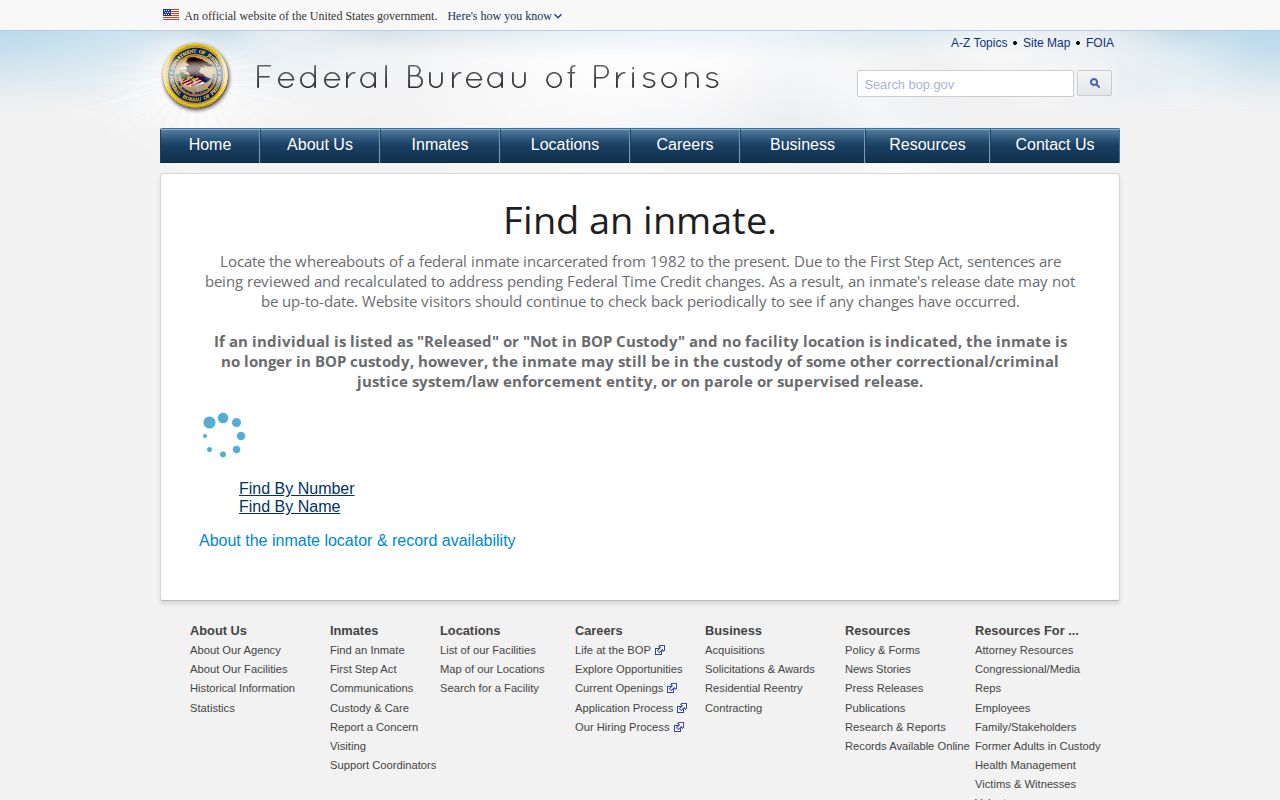
The screen identifies BOP status. It does not certify the end of all federal court supervision or exclude a later booking elsewhere.
Federal Release Record Meaning
A BOP result with a past release date and no current facility means the individual is no longer in BOP custody on the information displayed. The word released should not be expanded beyond that system. Federal supervised release is a court-ordered community status that can continue after prison. A person may also be transferred to ICE, state authorities, or another custodian.
- BOP custody
- Federal prison custody administered by the Bureau of Prisons.
- USMS custody
- Federal pretrial, transport, writ, or transfer authority administered by the Marshals Service.
- Supervised release
- Court-ordered federal community supervision after imprisonment.
- Transfer
- Movement to another custodian rather than release into the community.
When sources appear to conflict, note who reports each date. A court can order release, USMS can process a transfer, and BOP can post a custody end on different days. Ask what each field measures before treating one timestamp as an error.
Match Federal Inmate Identity
Federal names are not unique. Compare register number first, then full name, age, sex, race, case number, conviction district, and known sentence facts. A spelling match alone is a discovery lead. A person can also have a county booking, state sentence, federal case, and immigration episode at different times.
Build the timeline by agency. Label a BOP date as BOP, a Person County jail exit as sheriff data, and a detention order as a court event. “Released by BOP” and “booked by a county two days later” are not inherently inconsistent. They can describe two valid custody episodes.
Note: Use the federal register number whenever it is available to avoid a name-only mismatch.
Person County Federal Handoff
If Person County staff says the person was released to USMS, the local custody event ended in a custodian-to-custodian transfer. Search the federal docket for detention, release, commitment, sentencing, and designation events. A BOP record may appear later if the person is sentenced and designated to a federal prison.
If the county record says ICE, use the ICE detainee locator promptly. ODLS has a much shorter recent-release window than BOP. If the record says NCDAC, use the state offender system. The USMS custody path explains why no general Marshals person-history search exists.
| County destination | Next check |
|---|---|
| BOP | BOP locator and federal docket |
| USMS | Federal docket, then BOP after designation |
| ICE | ICE ODLS current or recent search |
| NCDAC | North Carolina offender search |
The original sheriff record remains the best proof of when Person County relinquished custody. The receiving system answers what happened next.
Request Federal Release Records
Start with public sources before filing a records request. The locator provides basic BOP identity and release fields, while the federal docket can provide public detention, judgment, sentence, and supervised-release orders. If the person was released before 1982, use the National Archives route described by BOP.
A focused federal request should identify the register number, full name, date range, institution or district if known, and the exact public field needed. Do not ask BOP to explain a Person County jail record. Likewise, do not ask the county to certify the end of BOP custody. Each custodian controls its own transaction.
No BOP institution identified in Person County
Public access: BOP Inmate Locator
Historical pre-1982 route: National Archives
Case authority: relevant federal court docket
For a Person County booking followed by federal transfer, request the local entry-and-release summary separately through the sheriff. It may preserve the local exit time and receiving-agency field that the BOP locator does not show.
BOP Release Versus Supervision
Federal supervised release begins after imprisonment when imposed by the judgment. It is not administered as BOP confinement. Therefore, a BOP location of RELEASED can coexist with active federal supervision. The judgment and later docket events explain the term and any court action, while the locator remains a custody tool.
A later arrest, revocation proceeding, state case, or immigration hold can produce another custody event. Do not use a past BOP release date as a permanent statement about a person's current location. Confirm the relevant date and agency every time the question changes.
The Person County custody-source map helps separate the county, state, federal, and immigration systems. The central rule remains simple: identify who held the person, confirm that agency's exit, and then check whether another custodian received the person.
Reconcile Federal Release Dates
A federal judgment, USMS transfer, BOP admission, projected date, accomplished BOP release, and supervised-release term can all appear in one case. Record the agency and event with each date. A BOP release date answers when BOP custody ended. The judgment and later docket entries answer whether court supervision continued.
When a county exit and federal admission differ, allow for transport, court processing, and designation. If the person later appears in state or immigration custody, add another episode rather than changing the BOP record. A focused request should cite the register number, federal case number, and exact field that needs clarification.
Federal Release Follow-Up
Save the BOP register number, displayed release date, location wording, and date checked. Then compare the federal judgment for supervised-release terms and the docket for later action. A locator result can change with corrections or a new federal episode, so an old screen should remain dated. If a new custody question arises, conduct a fresh source check rather than treating the earlier release as permanent proof.
When a source changes, keep the earlier result dated and verify the current federal record again. Custody status is time-specific, and the agency that created the entry remains the proper office for clarification.
Closed Person Prison Is Unrelated
Former Person Correctional Center is not part of this federal custody system and is not a current inmate locator. The NCDAC Dan River Prison Work Farm page says the former Roxboro building now serves as its Roxboro Satellite Training Center. Dan River's operating prison is in Caswell County. A historical state inmate connected to the closed Person facility belongs in NCDAC records, while the federal custody question must stay with the federal system named in the transfer or release record.