
Person Supervision Status Types
North Carolina uses three related terms that should not be treated as synonyms. Probation is a court-ordered community sentence and may begin without a prison stay. Post-release supervision, often shortened to PRS, follows confinement for a Structured Sentencing felony. Parole is a conditional release route that remains relevant mainly to older eligible offenses. Structured Sentencing generally governs offenses committed on or after October 1, 1994 and ended discretionary parole for those sentences.
The North Carolina Post-Release Supervision and Parole Commission sets PRS conditions and makes decisions in eligible older-law parole cases. It does not select the routine prison-release time for an ordinary Structured Sentencing case. That distinction matters when a Person County result says “Active Probationer-Parolee.” The search label groups several community statuses. Open the detail and read the sentence, offense date, supervision history, and displayed status before calling every record parole.
Release and discharge also mark different points. A person released from prison to PRS has crossed out of prison custody, yet the sentence continues in the community. The public detail may therefore show an accomplished prison release beside an active supervision status. Later, an inactive record or termination entry can document the end of supervision. Keep both dates when verifying a completed state case.
| Status | How it begins | What release means |
|---|---|---|
| Probation | A court orders community supervision, with or without an earlier jail term. | It may not reflect a state-prison release. |
| Post-release supervision | A Structured Sentencing felony term moves from prison to community control. | Prison custody ended, but the sentence remains active. |
| Parole | The Commission conditionally releases an eligible older-law prisoner. | Release is subject to Commission terms. |
| Discharge | The sentence and applicable supervision reach their legal end. | It is different from the earlier prison exit. |
Verify Person Post-Release Supervision
Use the NCDAC Offender Public Information search for a state sentence or a North Carolina community-supervision record. The form covers active prisoners, probationers, parolees, and historical records back to 1972. It does not include Person County jail-only bookings. A county release should first be confirmed through the sheriff when no state sentence or supervision event exists.
- Select Active Probationer-Parolee when active supervision is expected. Use All if the status is uncertain.
- Enter the offender number when known. Otherwise use the name and narrow the result with birth date, age, sex, race, or another displayed field.
- Compare the full identity, offender number, offense, conviction county, and sentence dates. A name-only match is not enough.
- Read the exact active status and supervision history. Distinguish probation from parole or PRS through the underlying sentence.
- For a completed case, repeat the search under Inactive and look for the supervision termination or discharge facts.
The official NCDAC search form below shows the available identity and status routes.
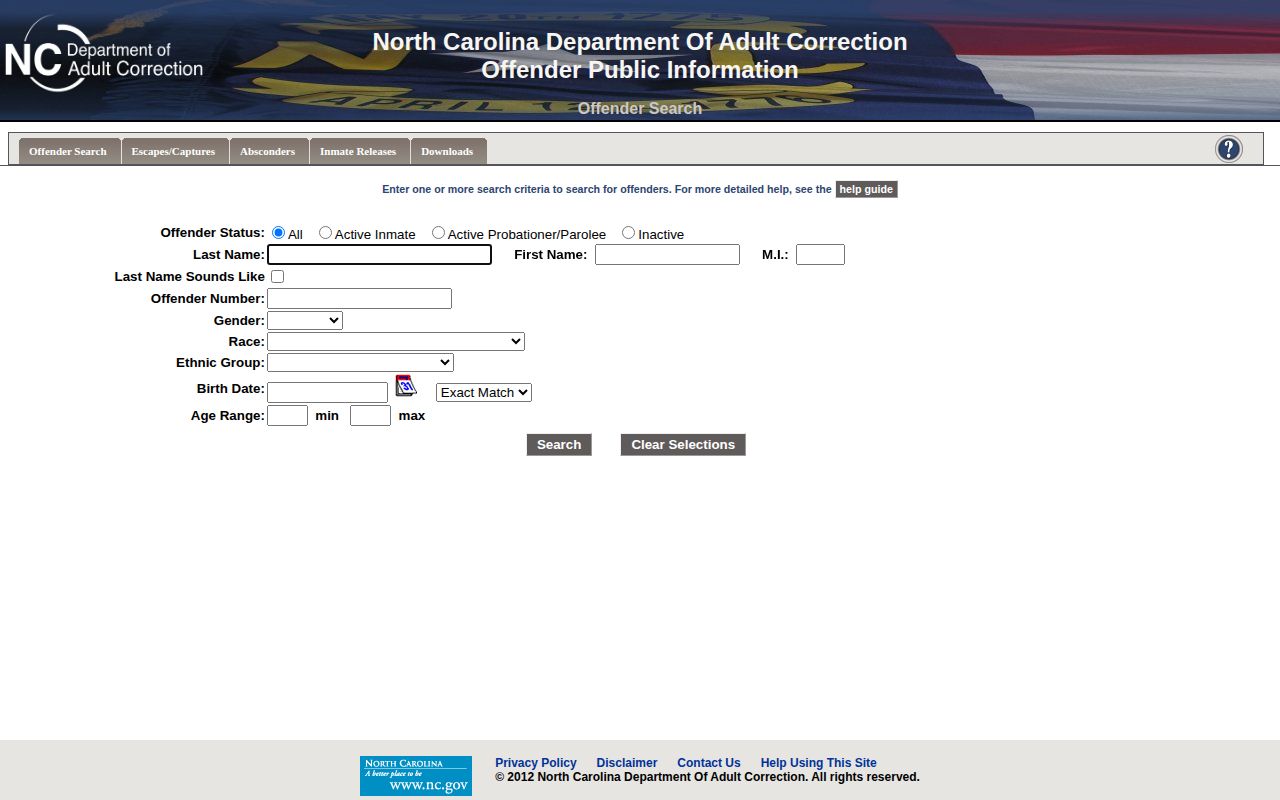
The result must be read as a state record. It cannot confirm a local jail exit that never entered NCDAC or Community Supervision.
Important: A prison release date and a sentence discharge date may differ. Active supervision proves a continuing state relationship after release.
Match Person Supervision Records
Names repeat, and one person can have several valid custody records. Match the middle initial, aliases, date of birth or age, offender number, offense, conviction county, and sentence dates as far as the public detail permits. The offender number is usually a stronger match than spelling. A sounds-like name search or a birth-year range can find candidates, but it also raises the risk of selecting the wrong person.
Build a short timeline when the record has more than one episode. Mark the state prison admission, accomplished prison release, start of PRS or parole, any revocation, and the eventual inactive or discharged status. Probation may also appear after a court judgment without a prior prison release. If an online detail remains ambiguous, request basic admission, release, sentence, and supervision dates through the NCDAC public-records channel. NCDAC is not the custodian for a Person County jail-only booking.
- Absconder
- A person whom the supervising agency alleges is avoiding supervision.
- Revocation
- A formal action that may return a supervised person to custody after a violation.
- Discharge
- The end of the sentence or supervision obligation shown by the responsible authority.
- Detainer
- A request or hold from another authority that may affect custody or release.
Person Supervision Office Check
An official NCDAC Person County resource document identifies Community Corrections-Roxboro as a local supervision contact. The document is older, so confirm the office location, telephone, and visiting instructions before going there. This office is a practical second step when the public offender detail shows active supervision but does not make the current office clear. It should not be used to guess an individual officer or reporting schedule.
Community Corrections-Roxboro105 South Main Street
Roxboro, NC 27573
336-599-3611
Official Person resources document
Commission process questions can be directed to the North Carolina Post-Release Supervision and Parole Commission at 919-716-3010. A public caller can ask about agency process or the correct office route. Personal conditions and reporting instructions come from NCDAC and the supervising office, not from a third-party roster or a county jail record.
Note: Confirm the Roxboro office details before a visit because the cited NCDAC directory item is not a newly issued listing.
Person Release Absconder Status
NCDAC maintains a live absconder list for people alleged to be avoiding probation, parole, or PRS. The research-day list included a record tied to Person County, but that individual status is not safe evergreen copy. The list changes. Search the current state page rather than relying on a saved name or an old screenshot.
The official absconder channel is shown below as a dated interface example.
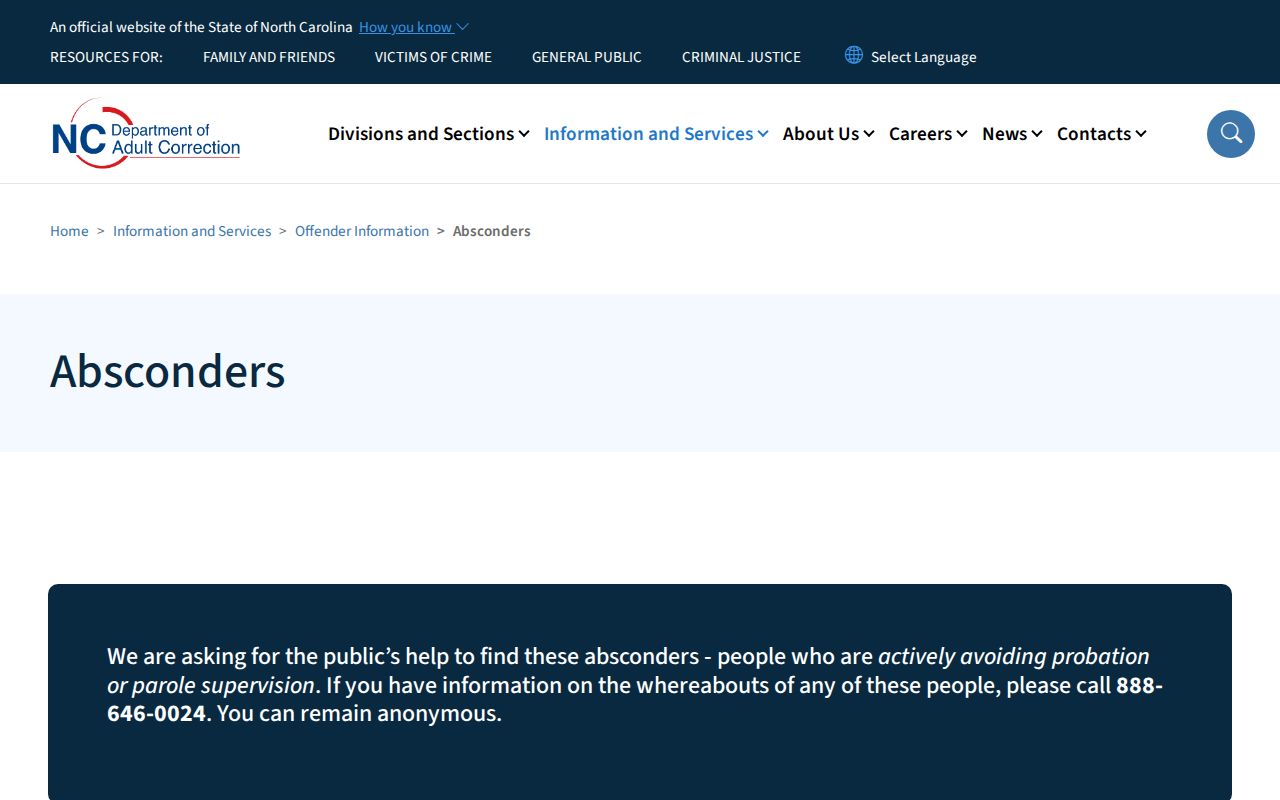
An absconder listing does not erase the earlier release. It alleges noncompliance after the person entered community supervision. Do not approach someone based on a web result. NCDAC publishes the tip line 888-646-0024 for current information, while emergencies belong with emergency services.
Person Parole Review Results
Start with the offense date. Ordinary Structured Sentencing cases for offenses on or after October 1, 1994 do not follow discretionary parole. Check PRS instead. An eligible older-law case may require review under N.C.G.S. § 15A-1371 and the Commission's process. North Carolina does not publish the routine public group-hearing calendar that many readers expect. Commissioners generally review files and vote independently rather than meeting face-to-face with the person.
The useful public substitute is the Commission's monthly discretionary parole review page, which posts case-review data and decisions beginning in September 2024. Use the source's own result terms. A report may show a denial with a later review, further investigation, or an approval-related action. Reasons and other Commission records can remain confidential. A narrow videoconference review process exists for juvenile-at-offense life-with-parole candidates, but it should not be generalized to routine reviews.
The official monthly results interface below is a results source, not a projected-date calculator.
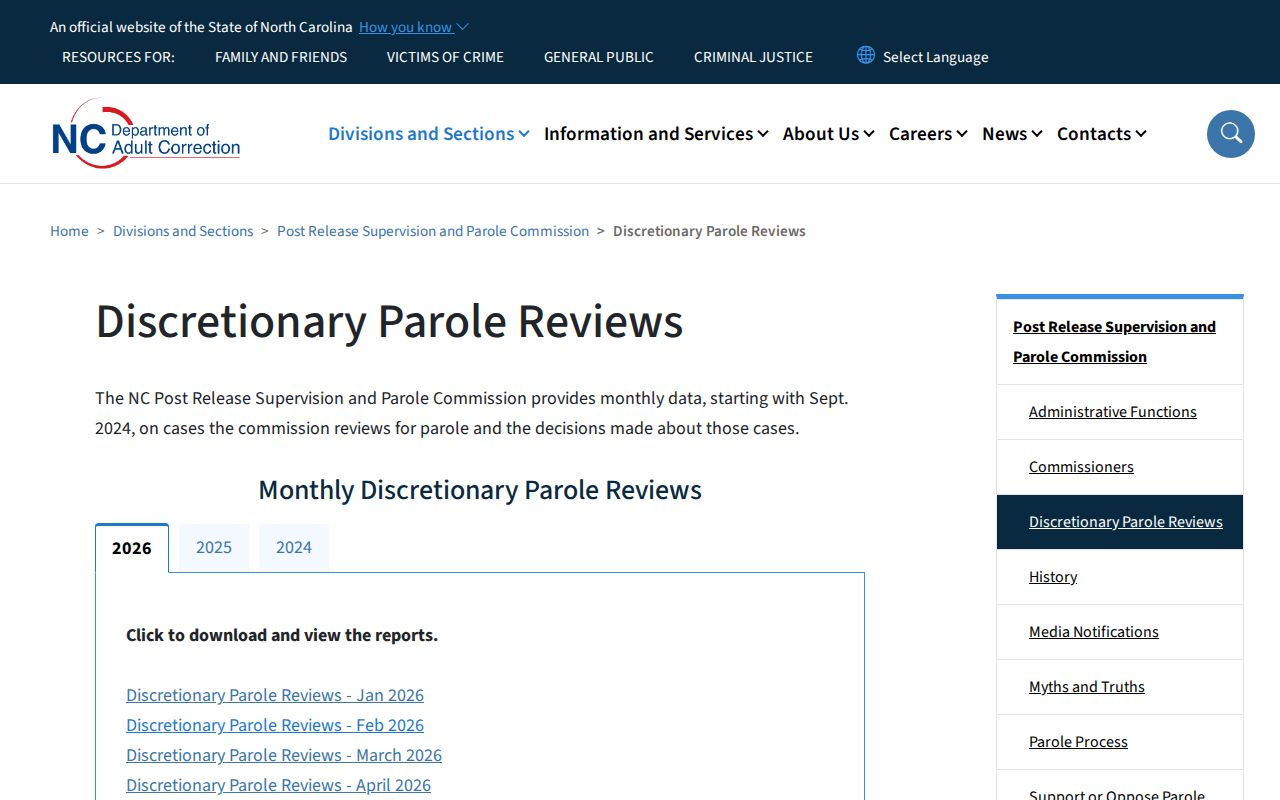
Match any listed case to the correct offender and sentence. A short media notice or monthly row is not a complete supervision history.
Person Supervision Changes
Community supervision carries agency or court conditions. A violation allegation can lead to a hearing, changed terms, or custody, but the public search should not be used to infer an unlisted event. Check eCourts for a public probation-violation or court action and compare it with NCDAC status. A court entry describes the judicial act. The state offender record describes the correctional or supervision status.
Supervision ends when the responsible authority records termination or discharge. For PRS, completion terminates the sentence under Article 84A. For probation, use the court and NCDAC history to confirm termination. For parole, use the Commission and offender record. The earlier prison exit can remain a valid accomplished release even if a later violation caused a new custody episode. The broader Person County released inmate search explains how to separate county, state, federal, and transfer records.
A county jail record and a state supervision record may both be correct. Person County can record a local exit or transfer, while NCDAC records the later prison or community-supervision event. Write down the reporting agency beside each date. If the sheriff says transfer to NCDAC, that event is not a community release. If NCDAC later shows release to PRS, the second event marks the state-prison exit.
When records conflict, ask each custodian what its date means. A court order can be effective before the jail finishes processing. SAVAN can post a status update after the source event. NCDAC can display a sentence calculation that differs from a later accomplished release. Do not average the dates or choose the latest one without first identifying the authority, physical custodian, and event recorded.